Slider

...

Tuesday, January 29, 2013

Astronomy Seminar: Exoplanets

A Fascinating Talk Delivered 

Mr. Frederick “Bamm” Gabriana conducted a talk last January 19, 2013 about his experiences in Sokendai Asian Winter School in Tokyo, Japan. The talk was held at the Astro-1 room of the Research and Development Building.

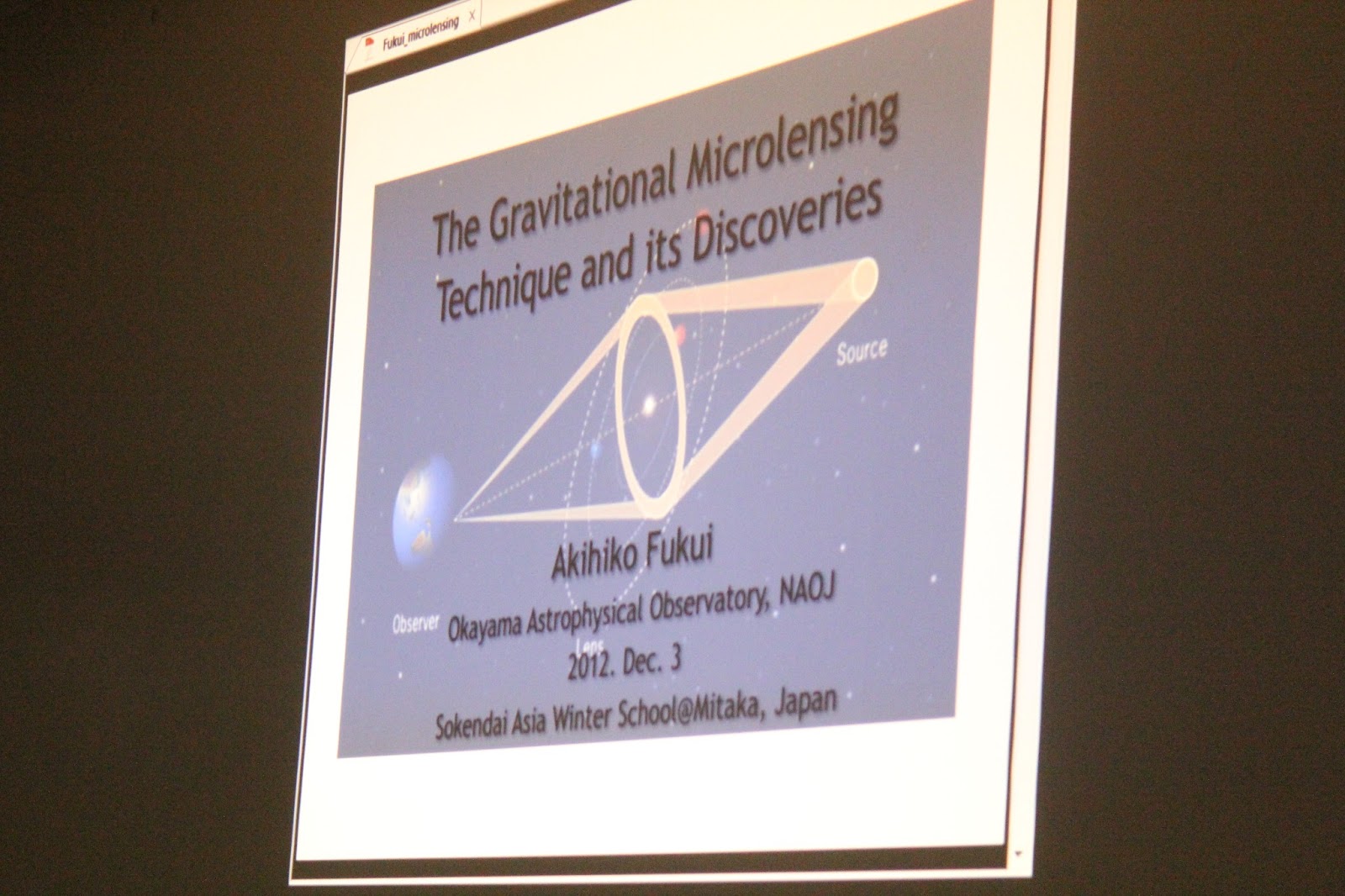
The talk started at about 1:30 in the evening, with the room filled with RTU Bachelor of Science in Astronomy Technology students. At first, Mr. Gabriana presented a series of powerpoint presentations which are directly from the instructors of the Sokendai Winter School. The First presentation was about the scholarship offerings of Sokendai (tr. Graduate University for Advanced Studies). As they were encouraged by their instructor in Japan, Mr. Gabriana encouraged the students to take the MEXT scholarship too. The MEXT scholarship of Sokendai is by far the scholarship offer that grants a student a significant amount of allowance than the other offers. All of the students were suddenly enticed to take the scholarship but it is only recommended for 4th year students. The next presentation afterwards was about the Strategic Exploration of Exoplanets and Disks (SEEDS) with Japan’s Subaru telescope. Various methods of detecting and observing different properties of exoplanets were then discussed such as the Radial-Velocity method, Transiting Method, Gravitational Microlensing and also Direct Imaging.


 To end the discussion, Mr. Gabriana showed the students an amazing infrared image of an exoplanet that they themselves “took” and processed. Mr. Gabriana explained how they processed the image of a star GJ 178 with complex commands just to make the exoplanet GJ 178b visible. This fascinated the students especially those who are fond of astrophotography.


Surely, the students learned a lot from Mr. Gabriana’s talk. The discussion ended at about 4:00 pm.

Written by: Jhan-Curt Fernandez

RTU-AstroSoc’s First Astrophotography Contest

Astronomy Photography

The Rizal Technological University Astronomy Society held its first astrophotography contest last January 19-20, 2012 at the RTU Boni Campus quadrangle. This event was for the selection of a sole winner who will be the representative of the RTU AstroSoc for the upcoming Philippine Atmospheric, Geophysical and Astronomical Services Administration’s first astrophotography contest this coming February 18-20 2013.


All of the mechanics were explained by the current RTU AstroSoc president, Mr. John Christian Lequiron, at the start of the event. It was stated that to be a qualified contestant, one must be an officially-enrolled Bachelor of Science in Astronomy Technology student of RTU, a member of the RTU AstroSoc, and owns his/her own camera, of course.  All of the contestants were permitted to use any telescopes and optics available. Furthermore, seven hours (9 pm to 4 am) were given to each contender for them to take pictures of celestial objects; and at the end of the allotted time, each should submit three images without any means of editing. The images as well as the contestants themselves were judged based on these...


CRITERIA:

20% Creativity


20% Image Quality


30% Originality


30% Mastery of Equipment


=100% TOTAL


After the telescopes were brought down to the campus quadrangle, each contestant quickly selected their telescope of preference and took pictures with different techniques. The contestants were Faye Albayda (1st year), Miguel Artificio (5th year), Frank Batin (3rd year), Justin Cejalvo (1st year), Margareth (2nd year) and Marycon (1st year) Custodio, Julie-Ann Delda (1st year), Val Gerald Garrido (1st year), Jeroh Hiyastro (1st year), and Jason Kalaw (1st year). Each chose their favourite celestial objects as subjects of their images. The competition went smoothly under the glare of the waxing gibbous moon during that time.


Following the thorough assessing of the selected judges who are Ms. Ruby-Ann Dela Cruz,Mr. Ryan Guido, Mr. Norman Marigza and Mr. Kelvin Martinez; the top three winners were Miguel Artificio, Frank Batin, and Margareth Custodio respectively. Due to some circumstances, the judges decided to do another astrophotography contest with only the top three winners. A winner will be chosen from that point WHO will be the representative of the RTU-AstroSoc for the coming PAGASA's First Astrophotography Contest.

Written by: Jhan-Curt Fernandez

Comet ISON

Peak for the upcoming Comet ISON 


A freshly discovered comet has contributed a slam on today's news. C/2012 S1 or commonly known as Comet ISON was the name given for the comet, in lined with the organization who made the discovery. The International Scientific Optical Network (ISON) in Russia has the credit for the detection of this heavenly body. The said comet has a potential to put a spectacular display on the sky.

Russians Vitali Nevski and Artyom Novichonok are the ones who revealed the new found low-mass member of the solar system by photographs taken on September 21, 2012 using a 15.7 inches (0.4 meter) reflecting telescope of the ISON. Similar to other comets, they move in a highly elliptical orbit and undergoing great changes and appearance as it approaches and recedes from the Sun. According to study, it can be visible by August 2013 only through the aid of telescopes and binoculars. It becomes observable to the naked eye by late October or early November until mid January 2014. When the time the comet reaches its perihelion on late November, it may become very bright if it remains intact. In fact, their prediction says that it can turn to be as luminous as the full Moon.

Meanwhile, an amateur astronomer Mike Mattei had noticed that our planet would be passing the orbit of Comet ISON which can create a possibility for meteor shower around January 2014. Dust particles from comets produce the bright streaks known as meteors when they burn up in Earth's atmosphere.

Comet ISON would go through different constellations and planets like Mars and Saturn. The final comet that was seen on Earth was Comet Hale-Bopp in 1997. Another is the brief appearance of Comet 17P/Holmes in 2007. Comet ISON would surely mark in the 2013. The peak of Comet ISON would be a great phenomenon to be witnessed in the field of Astronomy. It is truly a blessing that we can remark such dazzling experience. 

By: Xyrene Freda B. Angeles

For more information about Comet ISON:
Earthsky
Space.com