The
SEAAN 2014 will be held at Rizal Technological University, Mandaluyong
City, Philippines on 16-17 December 2014. The event will be sponsored by
the Department of Science and Technology (DOST)-Philippine Atmospheric,
Geophysical and Astronomical Services Administration (PAGASA) and the
Rizal Technological University (RTU).
In addition to the National
Focal Points and 20 participants from the SEAAN member countries.
Interested local astronomy organizations should register online and are
advised to observe the important dates (November 19, 2014 deadline of subsmission of registration form).
The Conference aims to
promote cooperation in the field of education, research and
popularization of astronomy among Southeast Asian member countries. It
will be divided into business and scientific sessions. The business
session will be the 6th SEAAN Meeting and will be held on 16 December
2014. The scientific session will be held on 17 December and will
include plenary and invited talks and oral and poster presentations.
Please download and complete the registration form below and submit to Ms. Ruby-Ann dela Cruz, Head, Department of Earth and Space Sciences, RTU through her email address: bee1delacruz@yahoo.com OR rbdcruz@rtu.edu.ph.
*Note*
-There is no registration fee.
-Travel expenses and accommodations will not be shouldered by the organizers.
-You will receive an email of confirmation if you have successfully registered as participants.
For more information please visit:
http://www.pagasa.dost.gov.ph/events-archive/1475-6th-southeast-asian-astronomy-network-conference
Download form here.

Dare to dream... Reach the stars!
Friday, November 14, 2014

Friday, September 12, 2014
Why do the Sun and Moon appear to be the Same Size in the Sky?
Why do the Sun and Moon appear to be the Same Size in the Sky?
 |
|
https://blogger.googleusercontent.com/img/b/R29vZ2xl/AVvXsEg3uf3FGb4Qp7DyqE0uFow_jCsJppSKTJkOJeGbXv72W_HlnpRbybIn_HvCPeK3ikxmx9cb99PtXgoQdsnK7suMNaNsAxLe37t1C_Gm5jFRAuX2ofHj-GVUpuqFWkUPOzxpahydKZQJ0eo/s1600/different+stages+of+eclipse.jpg
|
The Sun and Moon’s
physical diameters are obviously different from each other, so what
causes them to appear in the same size? It’s their ANGULAR DIAMETER
that’s coincidentally almost the same. The angular diameter or
apparent size of an object is its apparent diameter as seen by an
observer in a specific point. Intuitively, the angular diameter of an
object changes as the observer’s distance changes.
How do we derive the
equation for the angular diameter?
 |
|
Figure 1: Angular Diameter
|


With
θd as
the angular diameter, it’s easy to see that the tangent of the
angular radius (half of the angular diameter) is equal to the actual
radius (D/2) over the distance.
Solving for θd:
Therefore the equation for
the angular diameter is:
Now we can use this to calculate for
the angular diameters of the Sun and Moon.
Note that the distances used were the average distance, since orbits are elliptical. The Sun’s corona is excluded in the diameter.
Note that the distances used were the average distance, since orbits are elliptical. The Sun’s corona is excluded in the diameter.
For the Sun: For the Moon:
D = 1 392 684 km D = 3474 km
l = 1.496 x 10⁸ km l = 384 405 km
D = 1 392 684 km D = 3474 km
l = 1.496 x 10⁸ km l = 384 405 km
As we can see, their angular diameters
are nearly the same with the moon being a little bit smaller, that’s
why when perfectly in line during a solar eclipse in a given
position, an annular or total eclipse could be seen; annular when the
moon is a little bit farther and a total eclipse when the moon’s
distance is enough to make its angular diameter equal or a little
greater than the Sun’s.
 |
|
http://www.mreclipse.com/SEphoto/TSE2006/image/T06-cmp105cx.JPG
|
BS-Astronomy Student
International Observe the Moon Night
September 6, 2014
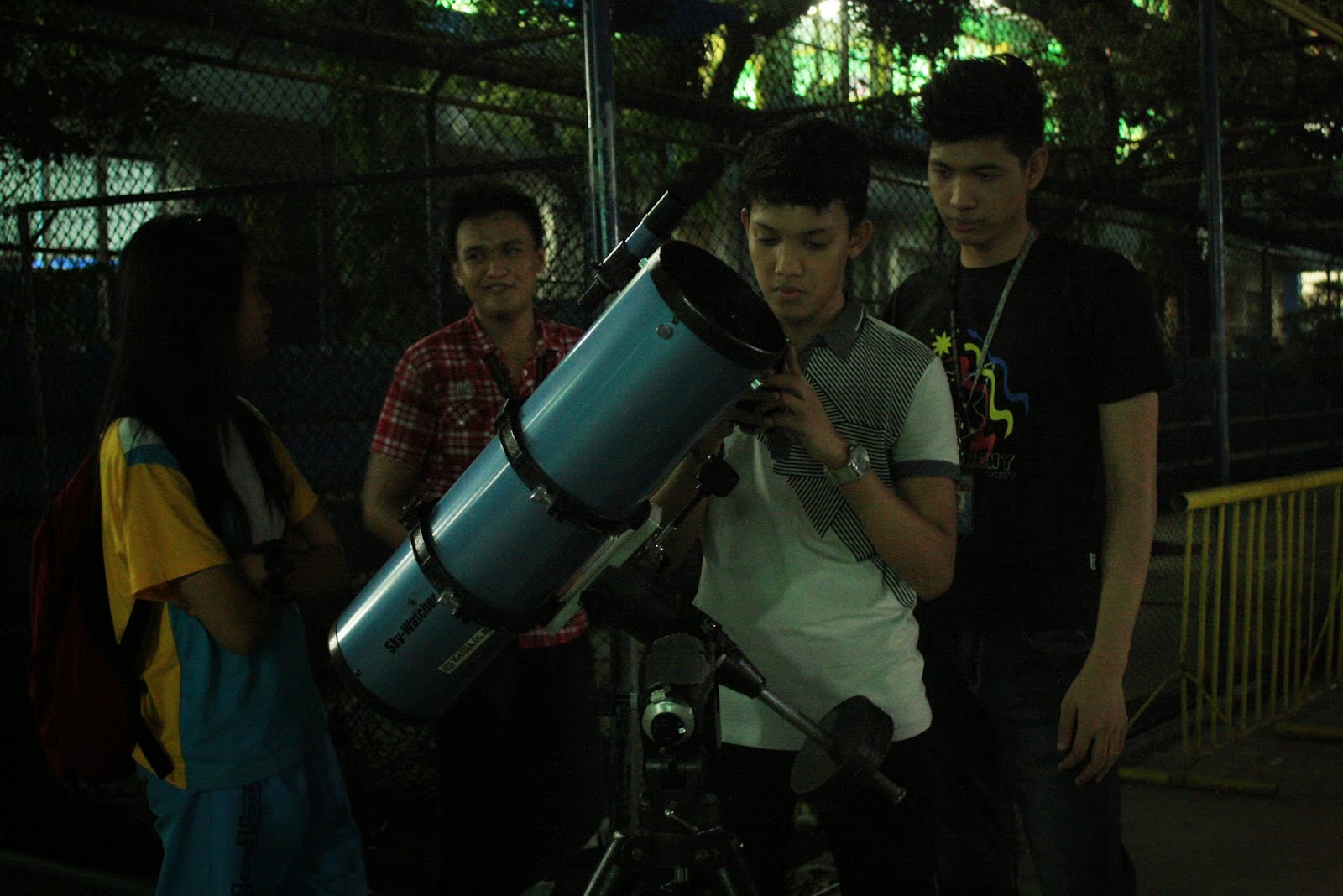
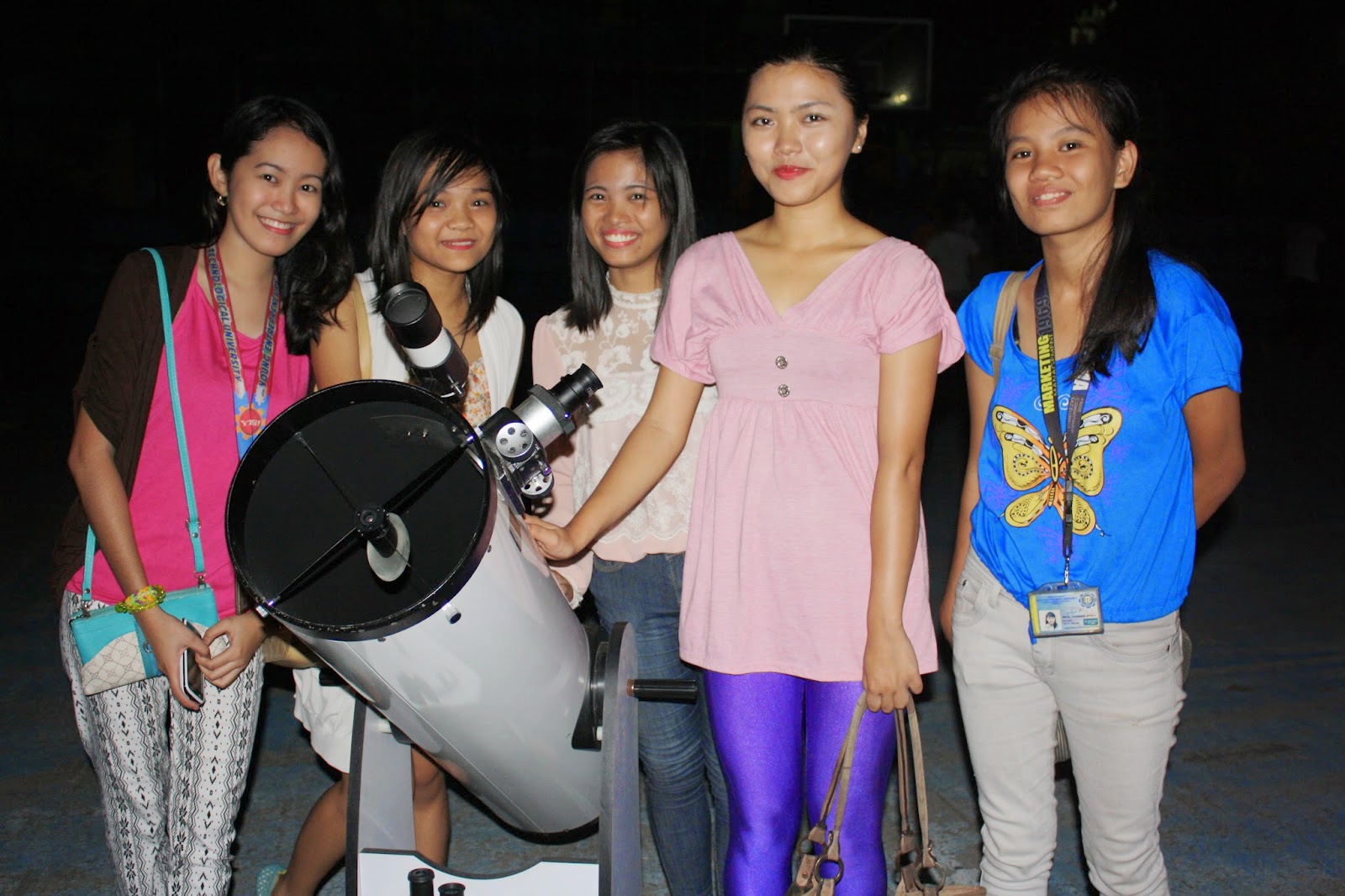
In celebrating the event “International Observe the Moon Night”, the Department of Earth and Space Sciences and BS-Astronomy Technology students conducted a lunar observation at RTU - Boni Campus quadrangle. The observation team was headed by Ms. Pauline Pearl Divinagracia and Mr.
Miguel Artificio, who were assisted by the 5th year OJT students, Jhoana Marie Tabios and Andrew Bayot. Other astronomy students were also there to help in conducting the public observation.
We started the observation by 6:00 PM PST. The sky condition was perfect by the time we started, with 0% cloud cover. We used 3 telescopes for this observation. The 10-inch newtonian reflector telescope, a 6-inch newtonian reflector telescope on a german equatorial mount and a 3-inch refracting telescope.
The lunar observation was attended by BS Astronomy students, and College of Arts and Science students and other students from various courses. A Natural Science instructor Ms. Rubelyn Narra invited her class to also participate the observation. While observing the moon, the observation team also showed the planets Mars and Saturn to the students which amazed them on how beautiful these planets are.
The nightsky has been perfect for moon observation until the clouds started forming at around 8:00 PM. We took advantage of the remaining hour for further discussions regarding the moon and nightsky observations. The troupe started packing up at 9 PM.
For more information about "Inomn (International Observe the Moon Night)" go to their website observethemoonnight.org/
Here are some of the pictures taken by the observation team during the observation.




Prepared by: Jhoana Marie Tabios, Andrew Bayot and Miguel Artificio
Subscribe to:
Posts (Atom)